Learning guide · Chapter 1
Hiragana, katakana and Japanese pronunciation
Learn to read both kana scripts in days, not months, and get the sounds of Japanese right from the start: charts, spelling quirks, the mora rhythm, and the handful of sounds English speakers get wrong.
The two kana scripts
Japanese is written with two phonetic scripts, hiragana and katakana, plus kanji. Each kana script has 46 basic characters for the same set of sounds; each character is a syllable (or a single vowel, or ん), not a letter. Hiragana carries grammar and native words; katakana is used mostly for loanwords (コーヒー, coffee), foreign names, sound effects and emphasis. You need both before anything else, and they're quick to learn.
あア a | いイ i | うウ u | えエ e | おオ o |
かカ ka | きキ ki | くク ku | けケ ke | こコ ko |
さサ sa | しシ shi | すス su | せセ se | そソ so |
たタ ta | ちチ chi | つツ tsu | てテ te | とト to |
なナ na | にニ ni | ぬヌ nu | ねネ ne | のノ no |
はハ ha | ひヒ hi | ふフ fu | へヘ he | ほホ ho |
まマ ma | みミ mi | むム mu | めメ me | もモ mo |
やヤ ya | ゆユ yu | よヨ yo | ||
らラ ra | りリ ri | るル ru | れレ re | ろロ ro |
わワ wa | をヲ o | |||
んン n |
The chart is regular: each row is a consonant, each column a vowel. The irregular spellings in romaji (shi, chi, tsu, fu) are just the way those sounds are pronounced, which the pronunciation section below covers.
How to learn them
- Learn to read, not to write. Tofugu's picture mnemonics (hiragana (opens in a new tab), katakana (opens in a new tab)) turn each character into an image; many people read all of hiragana after a few days, some after a few hours.
- Drill recognition. The free kana quiz (opens in a new tab) shows a character and you type its sound. Start with hiragana only, then add the combinations, then katakana.
- Then read real kana. The first levels of the free Tadoku graded readers (opens in a new tab) are written almost entirely in kana and have audio. You won't understand much yet; this is practice for your eyes.
- Katakana straight after hiragana. It's the same sounds with different shapes, and it tends to stay slower for longer because you see less of it. That's normal.
How long? Tofugu says a couple of days to a week for hiragana; VN Club says a week at most for both; TheMoeWay allows three weeks to a month including reading practice. Take whichever is true for you, but don't wait for perfect recall before moving on. The slow ones become automatic from seeing them thousands of times.
Voiced sounds and combinations
Two small marks change a sound: dakuten (゛) voices it, so か ka becomes が ga, and handakuten (゜) turns the h-row into p, so は ha becomes ぱ pa.
がガ ga | ぎギ gi | ぐグ gu | げゲ ge | ごゴ go |
ざザ za | じジ ji | ずズ zu | ぜゼ ze | ぞゾ zo |
だダ da | ぢヂ ji | づヅ zu | でデ de | どド do |
ばバ ba | びビ bi | ぶブ bu | べベ be | ぼボ bo |
ぱパ pa | ぴピ pi | ぷプ pu | ぺペ pe | ぽポ po |
A small ゃ, ゅ or ょ after an i-column kana merges into one syllable: きゃ kya、しゅ shu、ちょ cho、にゃ nya、ひょ hyo、りゅ ryu、じゃ ja、ぴょ pyo. Written full size, きや is two syllables (ki-ya); written small, きゃ is one (kya).
Katakana has extra combinations for sounds Japanese didn't originally have, built with small vowels: ティ (ti), ファ (fa), ウィ (wi), ヴ (vu). You'll pick these up from loanwords like パーティー (party) and ファン (fan).
Spelling quirks
- Particles keep old spellings. は is read wa, へ is read e and を is read o when they're particles. こんにちは ends in は for this reason.
- Long vowels. In hiragana a long vowel is written with an extra vowel: おかあさん (okāsan). A long o is usually written with う (ありがとう, arigatō) and a long e often with い (せんせい, sensei). In katakana a dash does the job: コーヒー (kōhī).
- Small っ doubles the next consonant. きって (kitte, stamp) is a different word from きて (kite, come). It's a held pause, one beat long.
- ん is its own beat. きんえん (kin-en, no smoking) and きねん (ki-nen, commemoration) are different words; romaji often uses an apostrophe (kin'en) to show the split.
- Look-alikes. シ and ツ, ソ and ン differ in stroke direction; ぬ/め, ね/れ/わ, る/ろ and さ/ち trip everyone up at first. They sort themselves out with reading volume.
Pronunciation
Japanese pronunciation is kind to English speakers: most of its sounds exist in English, the vowels never change, and spelling matches sound almost perfectly. You can be understood with an English accent. But a few minutes on the points below now saves years of an accent you'd later want to fix, and, more importantly, helps you hear Japanese correctly. As Refold's Matt puts it in an interview quoted in A Year to Learn Japanese (opens in a new tab), you can't pronounce things more accurately than you can hear them.
Rhythm: every kana is one beat
The unit of Japanese rhythm is the mora: each kana (plus ん, small っ and the second half of a long vowel) gets an equal beat. English squashes unstressed syllables together; Japanese doesn't. Getting long vowels and double consonants the right length matters, because they change words: おばさん (obasan, aunt) and おばあさん (obāsan, grandmother) differ only in length.
Sounds English speakers get wrong
| Sound | What to do |
|---|---|
| Vowels | Keep them pure and short. English turns 'o' into 'ou' and 'e' into 'ei' without noticing; Japanese お and え stay put. |
| う (u) | Lips relaxed and unrounded, not the pursed 'oo' of 'food'. |
| ら行 (r) | A light tap of the tongue behind the teeth, between English r, l and d. Never the English r of 'red'. |
| ふ (fu) | Blown between both lips, like blowing out a candle; the teeth don't touch the lip as in English 'f'. |
| し, ち (shi, chi) | Softer and further forward than English 'she' and 'cheese'. You'll be understood either way. |
| Quiet vowels | i and u often go nearly silent between voiceless consonants and at the end of です and ます: 'des', 'mas'. |
Tofugu's pronunciation guide (opens in a new tab) covers all of this with audio. Japanese also has pitch accent, a pattern of high and low pitch across each word; it's covered in the speaking chapter, and you can leave it for later.
Typing and fonts
Typing Japanese
Add a Japanese keyboard (IME) in your system settings; every desktop and phone has one built in. You type in romaji and the IME turns it into kana as you go, then the space bar offers kanji conversions:
nihongobecomes にほんご, and space offers 日本語.- Type
nnfor ん when the next letter is a vowel or y (konnnichihafor こんにちは), and double a consonant for small っ (kitte). - Prefix
xorlfor a small kana on its own (xtsu→ っ,xya→ ゃ), and type particles as spelled:ha,he,wo. - On a phone, the flick keyboard (swipe from each kana key) is faster once you're used to it.
Make your computer show Japanese, not Chinese, characters
Chinese and Japanese share character codes, so a device set to English often draws kanji with a Chinese font. Some characters look noticeably different: TheMoeWay uses 直 as the test. If your browser draws it the Chinese way, you'll be learning shapes Japanese readers don't use.
- Chrome/Edge: Settings → Appearance → Customize fonts, and choose a Japanese font such as Noto Sans JP or Meiryo.
- Firefox: in
about:config, movejato the front offont.cjk_pref_fallback_order. - Anki and Yomitan: set a Japanese font in the card or pop-up styling if they still show Chinese forms.
Where kana came from
Both scripts grew out of kanji used for their sounds (man'yōgana). Hiragana came from cursive brush forms of whole characters, and was long associated with women's writing; katakana came from pieces of characters, used by monks to annotate Chinese texts. You don't need this to read, but it explains why あ looks like 安.
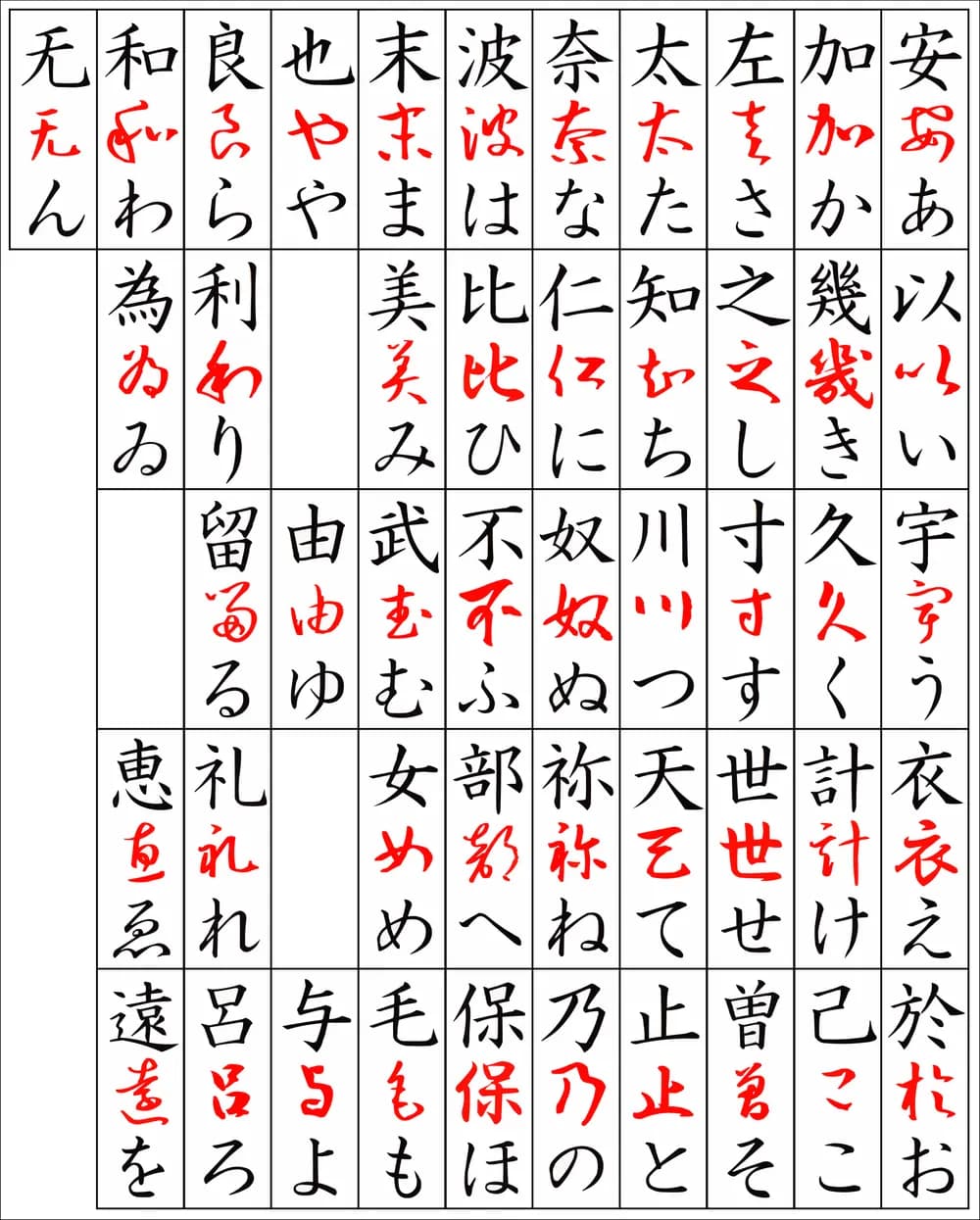
Image credits
Count your hours
immersionlog tracks every hour of anime, manga, visual novels, books, YouTube and podcasts, and shows how far you've come. Free.